Prefer to listen? Hit play above. Or keep reading below.
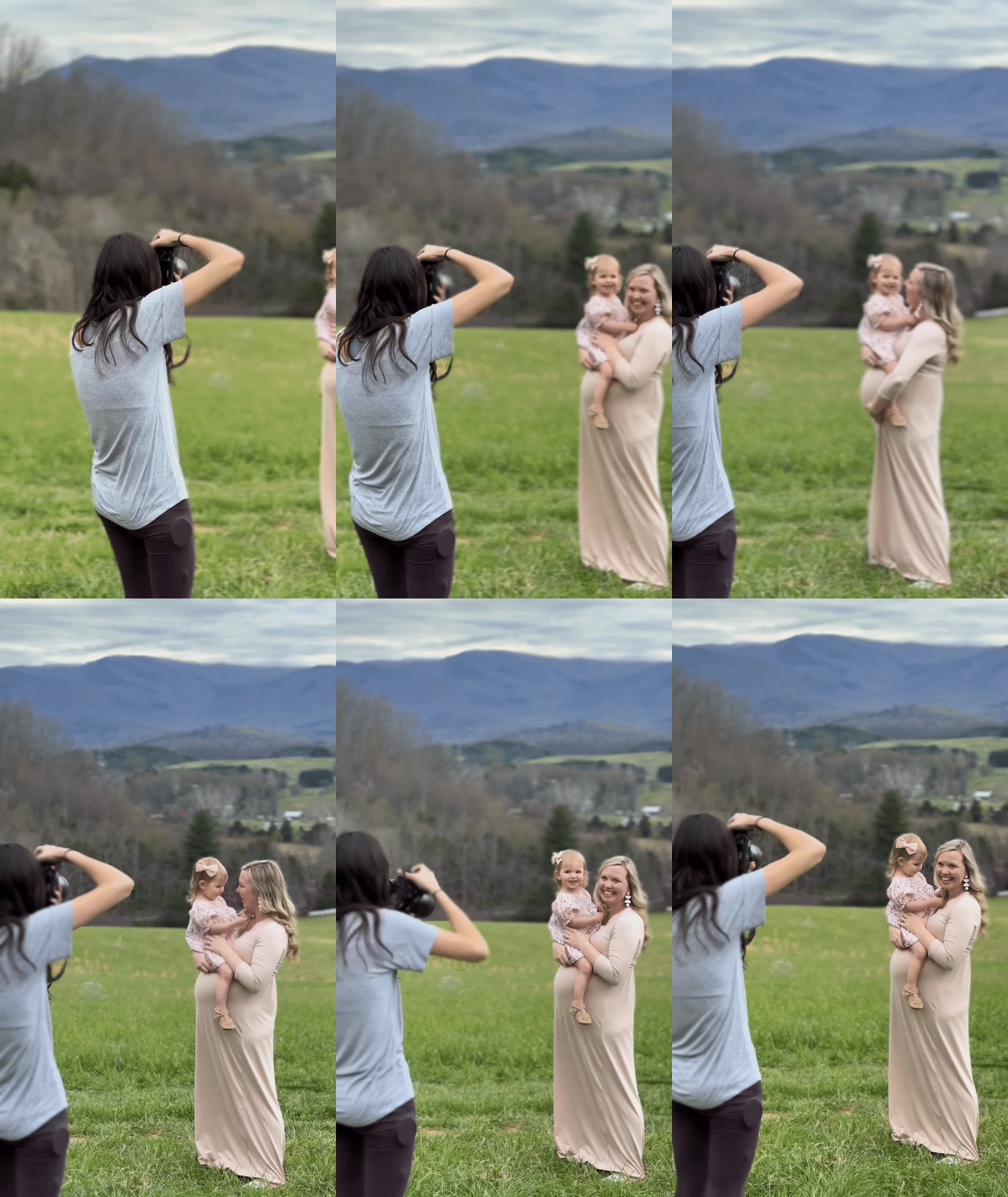
Before I had a posing workflow, I used to show up to sessions 30 minutes early and sit in my car scrolling Pinterest for pose ideas.
Then the family would arrive, my mind would go blank, and I'd forget half the poses I just looked at. I'd get home, start culling, and think, “I can't believe I didn't get a shot of just Mom and her babies.”
If you've ever frozen mid-session wondering what on earth to do next, you know exactly the feeling. You finish a pose, your brain goes a million miles an hour, and nothing comes to mind. There's this long awkward pause, and your clients can feel it!
This family posing workflow for mini sessions fixed that for me completely. It's the exact same sequence I run every single session, in the same order, with every family. And it gets me a full gallery in about 7 minutes of actual shooting time.
Why One Workflow for Every Single Session
I shoot a LOT of minis, in 10-minute time slots. A lot of my students shoot 15-minute slots, and even that isn't a lot of time when you really think about it.
So I do the exact same groupings and the same core set of poses with every single family I serve. That one decision does three things for me.
It removes the awkward “what do I do next” freeze, because I always know what comes next. I just run the play.
It keeps me efficient, which matters whether I'm shooting a 15-minute mini or fighting the light on a full session.
And it's repeatable. With a workflow, you never have to think of poses again. You can always add to it as you find things you love, but the bones stay the same.
People ask if doing the same poses every time gets boring. Honestly, no! Every family has a different dynamic, a different number of kids, different ages, different personalities. Every session is wildly different even when the groupings are the same.
And this same workflow works for everything. Minis, fulls, anything with a family. Only the base poses, the location, and the little variations change.
If you want to see this walked through live, I have a free posing class where I cover the whole thing. You can grab a spot at rebeccaricephoto.com/posing-class.
The 7-Minute Posing Sequence, Step by Step
This is the backbone. Same order, every time. The whole thing is built to move people as little as possible, so the session feels smooth instead of frantic. Moving with purpose is NOT the same as rushing.
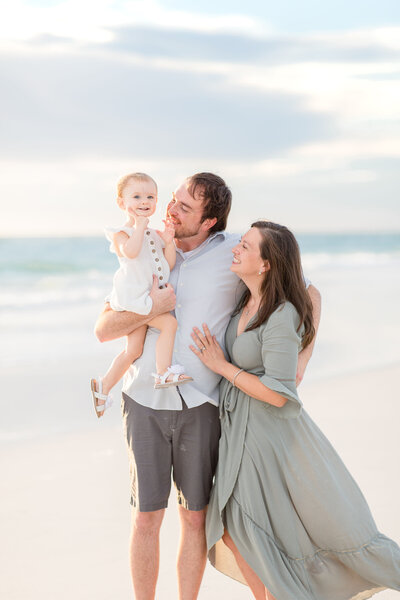
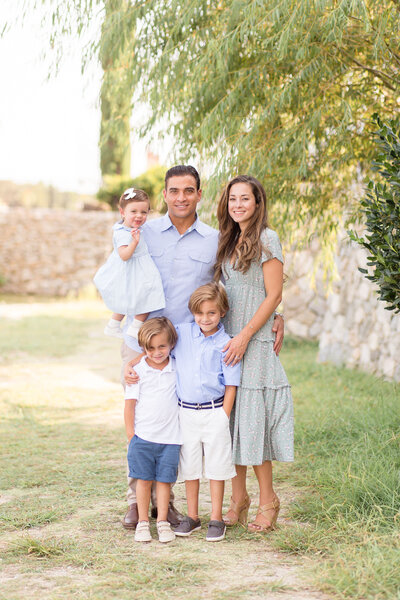
1. Whole family together. I always start here. It gets everybody comfortable, especially younger or timid kids who get to watch how Mom and Dad react to the camera. I grab a variety right away: everyone looking and smiling, Mom and Dad looking at each other while the kids look at me, a group hug, a group tickle. Whatever feels natural for that family.
2. Mom + kids. I pull Dad out and have him step BEHIND me, not off to the side, so the kids look toward my camera. Everyone else stays put. Whatever kid was on the right is staying on the right. This is usually the most tender setup of the whole session. Mom and her babies.
3. Dad + kids. Now the parents swap. Mom steps behind me, Dad steps into Mom's old spot, and the kids stay exactly where they are. To switch it up I'll trade one or two kids to opposite sides, and I'm very explicit about it: “this kid and this kid trade places, everybody else stay.” Clear directions keep things moving.
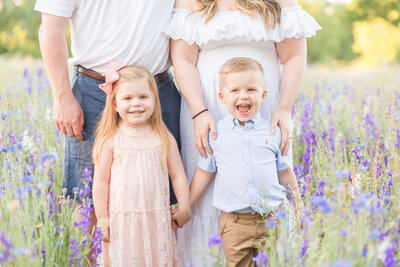
4. All the kids together. I pull BOTH Mom and Dad out so they're both behind me, and I squish the kids in. I get candids and posed shots here. I want to make sure we have some shots of just the kids!
5. Individual kids. This is a must-have. I get a full body AND a close-up of every single kid. I usually go oldest to youngest so the littlest one can watch and warm up, unless the youngest is already cooperating, in which case I shoot them first because their attention span is the shortest. If time allows, I'll add Mom with each kid and Dad with each kid too.
This step is huge for minis. My minis only come with five images, and if a family has four kids, the individuals alone eat up four of those five. That's exactly what encourages them to buy more.
6. Whole family together AGAIN. By now everyone's warmed up and looser, so the smiles and cooperation are better. I change it up from the start so we don't get duplicate poses. If they were sitting, I stand them up. If they were bunched, I do a line or a walking variation. This is also where I'll set up specialty shots, like the one where the kids cover their eyes in the foreground while Mom and Dad kiss, blurred, behind them.
7. Just Mom & Dad. I save this for near the end, and it's one of the most important shots I take. I can't tell you how many couples tell me the last photo of just the two of them was their WEDDING. I let them snuggle in and flirt, and the kids usually help make them kiss. If there's a baby, I'll offer to hold it or set it on a blanket.
8. “Is there anything else you want me to capture?” I always end here. And the key is I add, “I've got everything on my list.” That reassurance matters. If you just ask “is there anything else?” they're racking their brains wondering what you missed. When you tell them you got your list first, it hands them the chance to ask for one specific shot they had in mind. About 70% of the time, families say, “No, I think we're good!”
I keep this sequence on a cheat sheet I printed and laminated years ago. If you want that reference handy, my family posing cheat sheet has the whole thing laid out so you can bring it to sessions until it becomes muscle memory.
Move People as Little as Possible
Here's the part that keeps a session from feeling rushed even when you're moving fast.
I don't make families walk around between every grouping. I have one person step behind the camera while everyone else stays exactly where they are. The fewer moving pieces, the faster I go, especially with the families that have four or five kids.
And when those parents step behind me, my words have to do even more work, because Mom and Dad aren't right there to corral everyone. So I'm extra clear and extra quick. “You stay here, you go here.” Kids follow directions really well when the direction is obvious.
For more on prompts that work with real families, including reluctant dads and camera-shy kids, check out my posing tips for young families.
When a Toddler Derails Everything
It happens. It happens to me too! Even with a solid sequence, sometimes a two-year-old decides today is not the day. A few things that actually help.
Pivot to a movement prompt. If a toddler is restless, get everyone moving. Have a parent hold the kid while the whole group takes teeny tiny steps toward you as if you're all running. As long as the kid doesn't think it's a posed photo, the real smile shows up. I once had a little guy who kept his back to me the entire time, so I had Dad hold him and bounce him while we all “ran” toward me. His smile was priceless.
Let the parent hold them. Stop trying to get the kid to stand on their own and just put them in Mom's arms or up on Dad's shoulders. You'll get a better shot anyway!
Work around the meltdown, not through it. If one child is completely done, shift to another grouping and circle back. Pushing through a full meltdown costs you more time than a quick pivot.
And if you genuinely need to, BRIBE THEM. Gummies, M&Ms, whatever works. I pre-tell families to pack bribes, and the only rule is you have to follow through with the reward.
For what it's worth, truly difficult sessions are rare. In many years of shooting, I've only had two or three that were genuinely hard. The sequence bends. It doesn't break! That's the whole point of having one.
How a Repeatable Sequence Sells More Prints
Here's where the workflow stops being just a shooting tool and becomes a business tool.
When you improvise during a session, you default to your comfort zone. You shoot the same few configurations from similar angles with similar energy, and you end up with 40 frames that all look like the same shot.
That gallery does not sell.
A client can only buy what she can picture printing. If every image is basically the same, she picks one and she's done. But when her gallery has a whole-family shot, a tender Mom-and-kids moment, a Dad-and-kids grouping, the kids together, an individual close-up of each child, and a couple shot that reminds her why she married this person, NOW she has real choices. And people buy more when they have real choices!
That's exactly why those individual-kid shots matter so much in a mini. The package includes five images. The variety is what moves her past those five.
One more thing on return families, because people worry about repeating poses. I keep the core poses the same year to year and just add a little extra variety in the base poses. Kids change SO much that getting a comparable pose is a feature, not a bug. I have a family I've photographed for four years in the same pajama minis, and every year we take one photo that's exactly the same, kids on the same side, so they can line all four up and watch how much the kids have grown. I've never once had a client complain the poses were too similar.
If posing is the thing that stresses you out most during sessions, my Family Posing Course will change that! It walks you through my complete posing system. Not just what to do, but how to read a family, adjust on the fly, and come away with a gallery full of variety even on a tight timeline. Details at posing.rebeccaricephoto.com.
You don't have to white-knuckle your way through every session hoping it comes together. A system makes it come together. And now you have one!
Go shoot with it this week and tell me how it goes.
not sure where to begin?
here's a great place to start
Get practical business advice (did we mention, *free?*) every week to help you grow a thriving, profitable photography business! From behind-the-scenes editing tips, to posing and marketing - here are some of our most popular posts!

behind the lens
our *behind-the-scenes* membership program
Behind the Lens is our BRAND NEW MEMBERSHIP program geared towards family photographers! Each month our members receive a behind-the-scenes video of me shooting a REAL family session. As a bonus, I also include an EXCLUSIVE MASTERCLASS each month teaching on business topics I don't teach anywhere else! As our MOST AFFORDABLE, value-packed educational resource in our shop, it's a no-brainer for anyone looking to level up their family photography game! Join me every month behind the lens.
be my virtual shadow and learn while you watch me shoot real family sessions!
give me access!